Acoustic barriers for construction sites: how to install temporary noise barriers so they work
Temporary acoustic barriers are the first thing most sites reach for when construction noise becomes a problem. Put up well, they can take 5 to 10 dB off what the neighbours hear. Put up badly, they take off almost nothing and cost the same. This is the difference.
What a construction noise barrier actually does
A noise barrier works by blocking the direct path between the source and the listener. Sound then has to bend over the top and round the ends, and it loses energy doing so. That is all it does. It does not soak up noise from the whole site, and it does nothing for anyone who can still see the source over or past it.
Two things follow from that. The barrier has to break the line of sight between the plant and the windows you are protecting, and it has to be solid: no gaps at the joints, no gap at the bottom, no mesh or slatted panels.
Those are the numbers to design against. Manufacturers quote laboratory figures far higher than this (Echo Barrier's H10, for example, is tested to up to 42 dB in the lab), and the material is capable of that, but on site the barrier is limited by sound going over the top and round the ends long before the material itself is the weak point. Plan for 5 to 10 dB, and treat anything more as a bonus.
Where to put a temporary noise barrier
As close to the source as possible. A screen a metre from a breaker or generator casts a much bigger "shadow" than the same screen on the boundary fence 20 m away. For fixed plant such as generators, compressors, pumps and cutting stations, a three-sided local enclosure right next to the unit will usually outperform any amount of boundary screening.
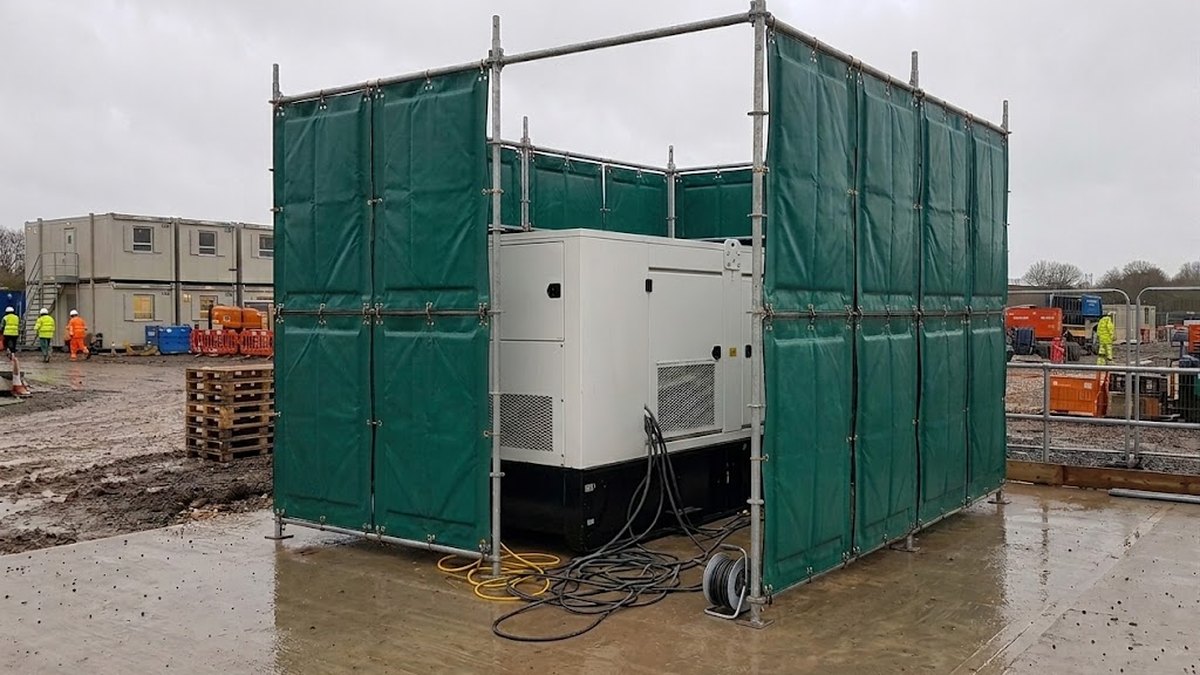
Between the source and the people who complain. Identify the nearest houses, the school, the offices, and put the screen on that side. Screening the whole boundary spreads the budget thin; screening the side that faces the receivers is what matters.
Where it will still be in the right place next month. Work moves. A screen set up for the demolition phase may be nowhere near the piling rig. Build the barrier plan into the programme and move it with the work.
How high and how long an acoustic barrier needs to be
The rule of thumb is that the barrier must hide the noisy part of the plant from the windows of the nearest receptor, including upper floors where they exist. Standing at the receptor, if you can see the exhaust of the excavator or the head of the piling rig over the top of the screen, the screen is too low for that receptor.
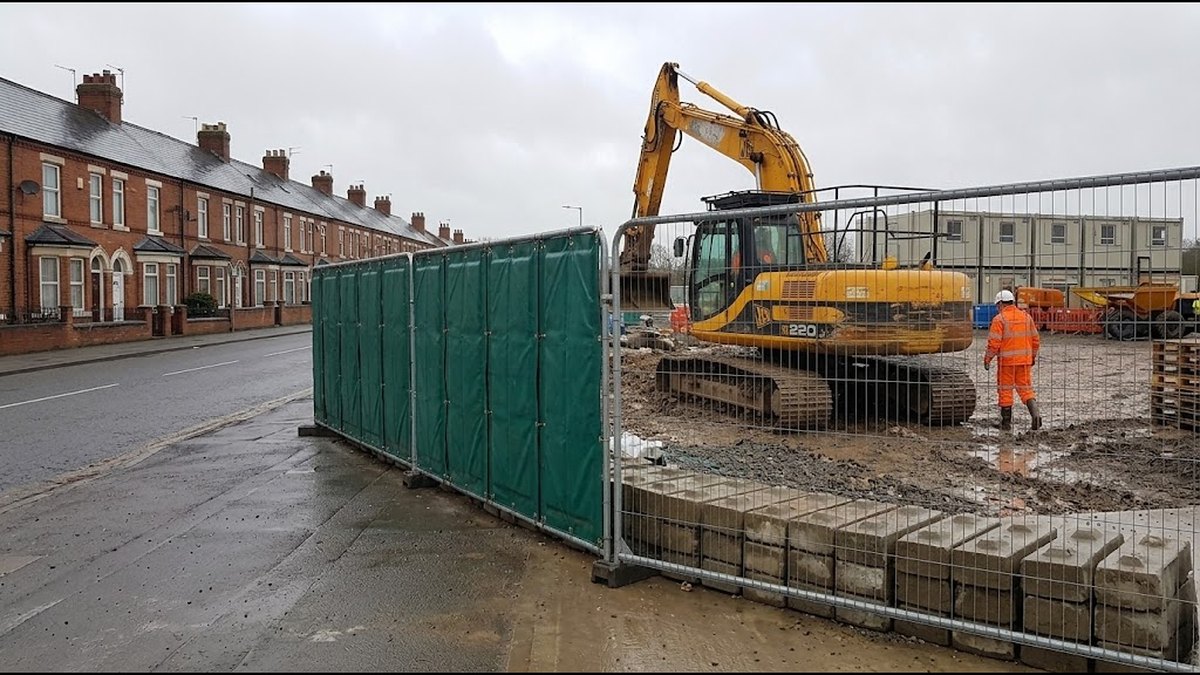
A 2 m Heras fence with acoustic panels will hide ground-level plant from ground-floor windows across a road. It will not hide a 20 tonne excavator from a first-floor bedroom. For that you need scaffold-mounted screens at 3 m or more, or a local enclosure around the plant instead.
Length matters as much as height. Sound goes round the ends as easily as over the top, so extend the barrier well past the source on both sides. A screen that only just covers the plant leaks at both ends.
Fixing acoustic barrier panels to Heras fencing
- Lap the joints. Overlap adjacent panels by at least 100 mm and clip or tie them together. A 20 mm gap between panels can undo most of the benefit.
- Close the bottom. Panels should reach the ground or the fence base. A gap under the screen lets noise straight through at the height where people hear it.
- Absorbent face towards the site. Most acoustic panels have an absorbent side (usually the mesh or fabric face) and a solid reflective side. The absorbent side goes towards the noise. Get this wrong and the panel bounces sound back across the site, which does not help anybody.
- Ballast the fence. Acoustic panels turn a Heras fence into a sail. Add blocks or bracing so it stays up in wind, and check it after storms.
- Hang them square. Panels hung crooked leave triangular gaps at the top and bottom of every joint.
- Keep gates covered. Vehicle gates are often left open all day on the loudest side of the site. If the gate is on the receptor side, either screen the plant locally or add a return screen inside the gate.
Mass matters, up to a point
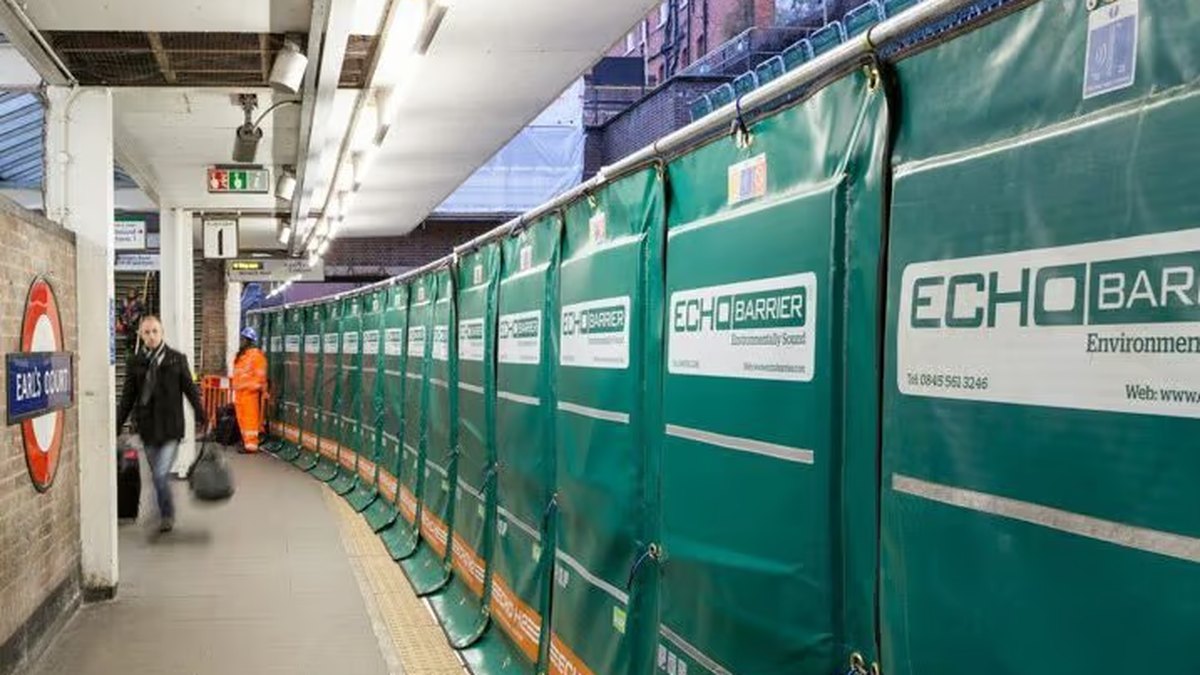
Any barrier needs enough mass to stop sound passing straight through it. The usual guidance is a minimum of about 10 kg per square metre, which is roughly a close-boarded timber fence. Above that, adding more mass gains very little, because the noise going over the top dominates. This is why a proper acoustic panel on a Heras fence and a solid plywood hoarding perform similarly, and why a heavy concrete wall is no better than either once the height is the same. Spend the money on height and coverage, not on weight.
Common acoustic barrier mistakes on construction sites
- Screens on the boundary while the loudest plant sits in the middle of the site, with nothing round it.
- Panels facing the wrong way, reflecting noise back towards the site cabins and the operatives.
- A gap of a few panels where the water bowser or the welfare unit was parked, never closed up.
- Screens from the enabling works phase left in place while the piling rig works 30 m away with no screening at all.
- Barriers so long and so well built that the site assumes the noise problem is solved, then breakers run outside the agreed hours.
How you know it is working. Continuous construction noise monitoring at the boundary shows the effect of a screen the same day it goes up. A drop of several dB in the LAeq for the same activity is the evidence that the Best Practicable Means in your Section 61 consent are in place, and it is the evidence you need if a complaint comes in anyway.
How much noise does a temporary acoustic barrier reduce?
On a real site, plan for 5 to 10 dB at the nearest houses: around 5 dB where the plant is still partly visible over the barrier and around 10 dB where it is fully hidden. Laboratory figures for the panel material are much higher, but on site the limit is set by sound passing over the top and round the ends, not through the panel.
Can you hire acoustic barriers for a construction site?
Yes. Temporary acoustic barrier panels that clip to standard Heras fencing are available for hire or purchase from several UK suppliers. Echo Barrier sells direct at echobarrier.co.uk and its panels are also stocked by ViC Group, GAP Hire Solutions and HermEq; most national fencing and site hire companies carry an equivalent product. Hire suits short phases such as demolition or piling; purchase usually makes sense for contractors who run several sites a year. We have no commercial link with any of them.
Where acoustic barriers fit in the wider picture
A barrier is one item on the Best Practicable Means list under BS 5228 and a Section 61 consent, alongside quieter plant, working hours, sequencing and community liaison. On its own it will not keep a site within its noise limits if the wrong plant is running at the wrong time. Used with the other measures, and moved with the work, it is one of the cheapest 5 to 10 dB you can buy. The point is to plan it, put it in the right place, and check it is doing what you expect.