Class 1
UKAS calibrated
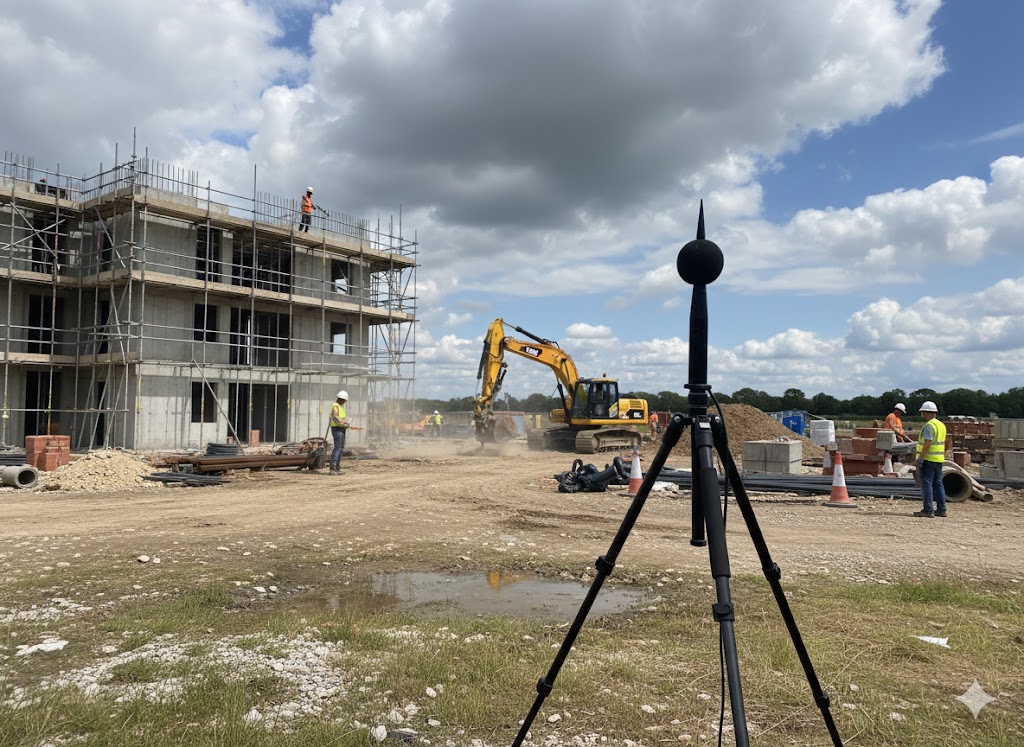
Class 1 sound level analysers in weather-protected outdoor kits, the same standard used for formal assessment work.
LIVE · SITE BOUNDARY N1 · LAeq,15min 68.4 dB(A) · LIMIT 75
Real-time construction site noise and vibration monitoring and Section 61 consents across the UK. We provide the monitoring equipment, live data, early-warning alerts and BS 5228 reporting, with experienced acoustic consultants behind it to help keep your site compliant and your programme moving.
The short version
We don't just supply a noise monitor. We monitor, understand the data and the legislation, and give you the alerts, reporting and advice needed to keep your site compliant and your programme moving.
Live on site
Every noise and vibration monitor on the site reports to one dashboard, so the whole boundary can be seen at a glance: current levels, trends and history for each position in one place. Early-warning triggers flag rising levels so action can be taken before they become an issue.

From the fence line to your phone
Class 1 sound level analysers in weather-protected outdoor kits, the same standard used for formal assessment work.
Vibration monitors on the same dashboard and alerts as the noise kit, for work near homes or sensitive structures.
Live and historic data available around the clock through the web viewer, from site, the office or your phone.
SMS and email alerts to the people you name as soon as a threshold is reached. Each alert is logged with the action taken.
Fence post, hoarding or tripod. No site IT needed. Typically installed in under an hour, with the dashboard live before we leave site.
Weekly summaries issued automatically, monthly BS 5228 compliance reports checked by a consultant and suitable for submission to the local authority.
What we do
We provide noise and vibration monitoring, Section 61 applications, or both. Details of each are below.
Core service
Class 1 noise and vibration monitors at your site boundary, feeding a live dashboard over 4G.
Consents and planning conditions
Section 61 prior consent under the Control of Pollution Act 1974, and the noise and vibration reports needed to discharge planning conditions. We prepare them and deal with the local authority for you.
The dashboard
An early-warning level below the limit gives the site team time to change something before a limit is reached, and the record shows what was done.
Class 1 sound level and vibration instruments, calibrated and traceable, logged at the same intervals used in consents and assessments, so the data can be relied on if it is questioned.
Weekly compliance summaries are issued automatically. Monthly BS 5228 reports are checked by a consultant and ready to share with the client or local authority.
How it works
Location, programme, nearest sensitive receptors and any noise or vibration limits already set. We reply with a fixed weekly price per monitor, normally within one working day.
Monitoring positions, early-warning levels and the alert list are agreed with you, and with the local authority where a consent or planning condition requires it.
Units go on a fence post, hoarding or tripod and connect over 4G. Installation typically takes under an hour and the dashboard is live before we leave site.
Alerts go straight to your team and reports to whoever needs them. If the data shows a developing problem, a consultant calls to talk through practical options.
Section 61, Control of Pollution Act 1974
A Section 61 consent is prior agreement from the local authority to your working hours, plant and predicted noise levels under the Control of Pollution Act 1974. Provided the works are carried out in accordance with the consent, it gives the contractor greater certainty and protection against complaints and Section 60 action. Many authorities expect a Section 61 application for major demolition, piling or out-of-hours working, and some planning conditions require one.
We prepare the full application: BS 5228 predictions for each phase, the Best Practicable Means schedule, proposed working hours and the monitoring proposal, then liaise with the environmental health officer until it is agreed. Turnaround is typically two to three weeks from plant list to submission.
Start a Section 61 applicationYou send us the phasing, plant schedule and site plan. We identify the sensitive receptors and the authority's likely thresholds.
Noise levels predicted at each receptor for each phase, with the mitigation needed to meet the ABC method threshold.
A mitigation schedule written for use on site: screens, plant selection, sequencing, hours and liaison.
Application submitted at least 28 days before works. We respond to local authority queries and agree the monitoring regime.
Noise and vibration monitoring set to the consent limits from day one, so compliance can be shown throughout the works.
Why us
A specialist service run by experienced acoustic consultants, members of the Institute of Acoustics, working on planning and construction noise since 2016. The people who set your thresholds also understand BS 5228, Section 61 and what the local authority will ask for.
A fixed weekly rate per monitor covering the unit, data, dashboard, alerts, reporting and consultant support. No set-up fee for standard installations. Section 61 work is quoted as a fixed fee.
Installing across the South West, London, the Midlands, the North and beyond. Units can also be shipped for self-installation with remote commissioning.
Questions we get asked
A weatherproof Class 1 sound level analyser is fixed at the site boundary or near the closest homes. It logs noise levels continuously, usually as LAeq over 15-minute or 1-hour periods, and sends them to a web dashboard over 4G. Levels are compared with the limits in a Section 61 consent, planning condition or local authority agreement, and the site team is alerted by SMS and email when levels approach or reach a threshold.
Monitoring is usually required where a Section 61 consent, planning condition or Construction Environmental Management Plan sets noise limits, and is often expected for demolition, piling or work near housing. Even where it is not a formal requirement, it provides evidence to respond to complaints and helps manage the noise risk on a programme.
There is no single national limit. Most local authorities use the BS 5228-1 ABC method, which sets a daytime threshold of 65, 70 or 75 dB LAeq,T at the nearest residential facade depending on the existing ambient level, with lower values in the evening and at night. The limits for a specific site are usually set in a Section 61 consent or planning condition.
BS 5228 is the British Standard for noise and vibration control on construction and open sites. Part 1 covers noise and Part 2 vibration. It sets out how to predict construction noise, assess it against thresholds, and apply Best Practicable Means to reduce it. Section 61 applications and local authority conditions are normally based on it.
Prior consent from the local authority for construction noise under Section 61 of the Control of Pollution Act 1974. The contractor applies before works start, setting out methods, plant, working hours, predicted noise levels and the Best Practicable Means to control noise. Working in accordance with the consent gives protection against Section 60 notices for those works.
Yes. An early-warning level and a limit level are set for each monitor. When either is reached, an SMS and email alert goes to the people named on the alert list straight away, so action can be taken while the level is still rising rather than after an exceedance.
It is charged as a fixed weekly rate per monitor, covering the unit, data connection, dashboard, alerts, reporting and consultant support. The rate depends on the number of monitors and duration. Section 61 applications are quoted as a fixed fee. Quotes are normally provided within one working day.
Typically within a few working days of instruction. Each unit connects over 4G, so installation usually takes under an hour and the dashboard is live the same day.
We install and support construction noise and vibration monitoring on sites across the UK, including the South West, London, the Midlands and the North.
Yes. Vibration monitoring (PPV, peak particle velocity) runs on the same dashboard and is usually needed where piling, demolition or vibratory compaction takes place near homes or sensitive structures. Ask about dust monitoring when you enquire.
Articles
Practical guides for site teams on noise, vibration, barriers, BS 5228 and Section 61.
Get a quote
Tell us where the site is, when it starts and what limits apply, and we will come back with a fixed weekly price per monitor, or a fixed fee for a Section 61 application, normally within one working day. No obligation.